
What weather conditions are best for drying laundry outside?
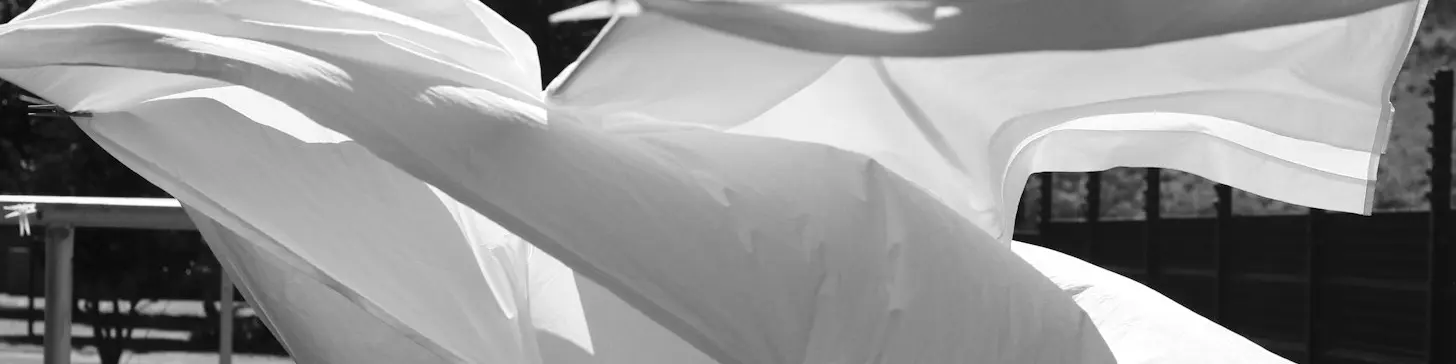
It's a pretty safe bet that everyone knows that a lack of significant rain is a given for drying, but many assume a hot, sunny day is the best drying day. It isn't, necessarily. A blustery 7°C (44°F) morning in October can easily outperform a still, muggy afternoon in July.
Wind matters most
A 2015 study published in Materials Physics and Chemistry found that the evaporation rate of wet fabric depends more on wind speed than on the fabric's own properties, and more than on temperature alone.1
When fabric dries, it creates a microscopic layer of humid air right at the surface, a kind of soggy halo. That layer acts as a barrier. It slows evaporation by reducing the moisture gradient between the fabric and the surrounding air. Wind breaks that layer apart and replaces it with drier air, allowing evaporation to continue at full speed.
Remove the wind, and drying slows dramatically, even on a warm day.
A sustained breeze of around 8-12 mph (13-19 km/h) is more useful than direct sunlight for drying. On a cold, blustery day with low humidity, your sheets can be dry in two hours. On a warm, still, humid day, they might still feel damp when you take them in.
Wind also physically agitates the fabric as it dries. This is why line-dried laundry is often softer than rack-dried laundry. The wind movement does something a static drying rack can't.
Humidity is the dealbreaker
Evaporation works because there's a difference in moisture concentration between your wet washing and the surrounding air. Dry air "pulls" moisture out. Saturated air doesn't.
At 100% relative humidity, thick fog for example, the air has no capacity to accept more water; evaporation slows to nothing. Cotton absorbs moisture from saturated air rather than just failing to release its own, its equilibrium moisture content at 100% humidity is around 24%, so your washing could end up damper than it started.
As a rule of thumb, look for relative humidity below 60 to 70%. DryTime factors this into the forecast automatically. Humidity alone isn't the whole picture though, our DryTimer tests have recorded a reasonable drying rate in cotton at 84% humidity even in the dark of an evening.
Another factor to check is the dew point. On a clear, still night, if the temperature and dew point are within around 3°C (5°F) of each other, your clothes are at risk of getting wetter from condensation forming on their surface.
Temperature still plays a part even below freezing
Warmer air holds more moisture. More precisely, higher temperatures create a greater difference in water vapour pressure between the fabric surface and the surrounding air, which drives evaporation more forcefully.2 Above 20°C (68°F) is genuinely the gold standard for rapid drying.
But cold doesn't mean impossible.
Below 0°C (32°F), something interesting happens. Water in wet fabric can freeze solid. Despite sounding like a disaster, the ice slowly converts directly to water vapour through a process called sublimation, bypassing the liquid stage entirely. It's slower than a warm day, but it works. Clothes left on a line in sustained frost will eventually dry.
Traditional Japanese textile practices use this deliberately. Yuzarashi (雪晒し), snow-bleaching, involves spreading high-end silk and linen on snow in winter sunlight, using the combination of cold, UV, and slow sublimation to clean and brighten the fibres without the harshness of heat.3 It's a technique centuries old. The physics is sound.
So yes: a cold, windy, dry day beats a warm, humid, still one. This can seem counter-intuitive at the time, because you can't always see or feel humidity.
Ultraviolet (UV) from sunlight helps
UV radiation does contribute energy that helps evaporate moisture. But sunlight's most interesting contribution isn't heat, it's chemistry.
When UV light hits damp fabric, it triggers a process called photooxidation. Sunlight reacts with water, atmospheric oxygen, and organic residues on the fabric's wet surface to produce a family of volatile aldehydes, including pentanal and hexanal.4 These compounds are genuinely pleasant to human noses, and they bind to cotton fibres well enough to persist through storage.
That's what "air-dried smell" actually is. Not cleanliness in the abstract, specific molecules, formed by sunlight, that we've evolved to associate with fresh outdoor air.
UV also acts as a mild disinfectant. Bacteria and dust mites are sensitive to sustained UV exposure. This is most effective on fabrics hung in direct sun and truly kicks in when the UV index is high.
Beware, UV degrades synthetic fibres and fades dyes over time. Dark colours and synthetics are better hung in shade on a breezy day than left in strong direct sun for hours.
The bacterial villain
There's a reason clothes dried slowly in low airflow have that damp, slightly sour smell. It has a name: Moraxella osloensis.
This common bacterium lives on fabric and is remarkably tolerant of drying conditions. When clothes dry slowly, high humidity, low wind, low UV, it colonises the fibres and produces a compound called 4-methyl-3-hexenoic acid. That's the smell. It's not dirt. It's not the washing machine. It's a bacterium breeding like rabbits because your laundry wasn't drying fast enough.
The fix is wind and UV, both disrupt the conditions Moraxella needs. A fast dry in moving air largely prevents it from establishing. A slow dry in still air is practically an invitation.
A note on air pressure for the curious (and mountaineers)
Lower atmospheric pressure, at altitude, means water molecules require less energy to escape from fabric into the air. A towel drying in Denver, Colorado, at 1,600 metres (5,250 feet) above sea level, will dry faster than the same towel under identical temperature, wind, and humidity conditions in London.
Day-to-day barometric pressure changes at sea level are too small to notice the effect. But if you've ever wondered why laundry dries unusually quickly in the mountains, this is why.
The ideal conditions
If you want a benchmark for the best possible drying day, the meteorological research points to roughly this:
- A sustained breeze of 12 mph (19 km/h)
- Relative humidity below 60%
- Temperature above 20°C (68°F)
- An hour or two of sunlight is always appreciated
In the UK, that combination happens most reliably between April and September, roughly between midday and 4pm. It's also not that common, which is exactly why having a forecast that tells you when it is coming is useful.
What DryTime uses
DryTime combines temperature, windspeed, gusts, humidity, precipitation, solar irradiance, UV, cloud cover, and air pressure into a single drying forecast for your specific location, updated hourly across 48 hours.
It doesn't tell you exactly how long your clothes will take, there are too many variables for that to be honest. What it tells you is how good the conditions are likely to be. The rest is down to you, your line, and your sheets.
Hero image credit: Photo by Hennie Stander on Unsplash
Last updated: by the DryTime family in Somerset, UK.